
How the obsession with an anti-Zionist litmus test is fracturing the American Left, and what we can learn from the undisputed masters of socialist electoral strategy: the German SPD of 1890–1914.
If you want to understand the current battle underway within the Democratic Party due to the Democratic Socialists of America (DSA) campaign strategy, look no further than the recent, baffling decisions of DSA to alienate their most successful champions.
In a moment when working-class Americans are desperate for economic relief, universal healthcare, and robust labor protections, the DSA leadership has increasingly decided that the true measure of a socialist is not their commitment to the working class, but their absolute adherence to a militant anti-Zionist litmus test.
This culminated in July 2024 when the national DSA withdrew its conditional endorsement of Representative Alexandria Ocasio-Cortez—arguably the most prominent and effective democratic socialist in modern American history. Her crime? She hosted a nuanced panel discussion on combating antisemitism with Jewish experts, co-signed a statement supporting defensive missile systems like the Iron Dome, and voted for a resolution condemning the denial of Israel’s right to exist—a resolution that passed the House 412 to 1. The internal warfare has only escalated since: a resolution to censure her, accusing her of “tacit support for Zionism,” was introduced at DSA’s 2025 national convention and still sits before the national leadership.
This is not strategy. This is a purity spiral. It is the behavior of a niche ideological club or sect that has given up on governing and prefers the moral comfort of perpetual marginalization.
For the new generation of socialists who genuinely want to build power and change material conditions, this self-immolation is tragic. But one does not have to reinvent the wheel to figure out how to do this right. One simply needs to look back at the most spectacularly successful socialist political machine the world has produced: the German Social Democratic Party (SPD) between 1890 and 1914.
The historical SPD did not win by purging its allies over single-issue foreign policy tests. They won through relentless organizing, deep community building, and a ruthless, pragmatic electoral strategy that the modern DSA desperately needs to relearn.
The Erfurt Synthesis: Balancing Theory and Reality
When the SPD was finally legalized in 1890 after twelve years of severe state repression under Bismarck’s Anti-Socialist Law, they faced a massive dilemma: How do you maintain a revolutionary Marxist ideology while operating within a deeply conservative, capitalist empire?
Their answer was the 1891 Erfurt Program, a brilliant act of political duality that the historian Carl Schorske called the “Erfurt synthesis.”
The first half gave the radical base what they wanted: sweeping Marxist theory declaring the inevitable collapse of capitalism. But the second half—the actual marching orders for the party—was entirely pragmatic. It laid out a series of immediate, concrete democratic demands: an eight-hour workday, expanded social insurance, the extension of suffrage to women and to the state elections still rigged by class-based franchises, and the right to unionize.
The SPD understood a fundamental truth that the modern DSA seems determined to ignore: You cannot feed the working class with ideological purity.
They did not demand that every voter or allied politician pass a rigorous test on Marxist dialectics. They united a massive coalition around tangible, material improvements to workers’ daily lives. By focusing relentlessly on these “minimalist” goals, they built trust—and where a hostile Imperial state blocked them from writing their demands into law, they delivered through institutions of their own.
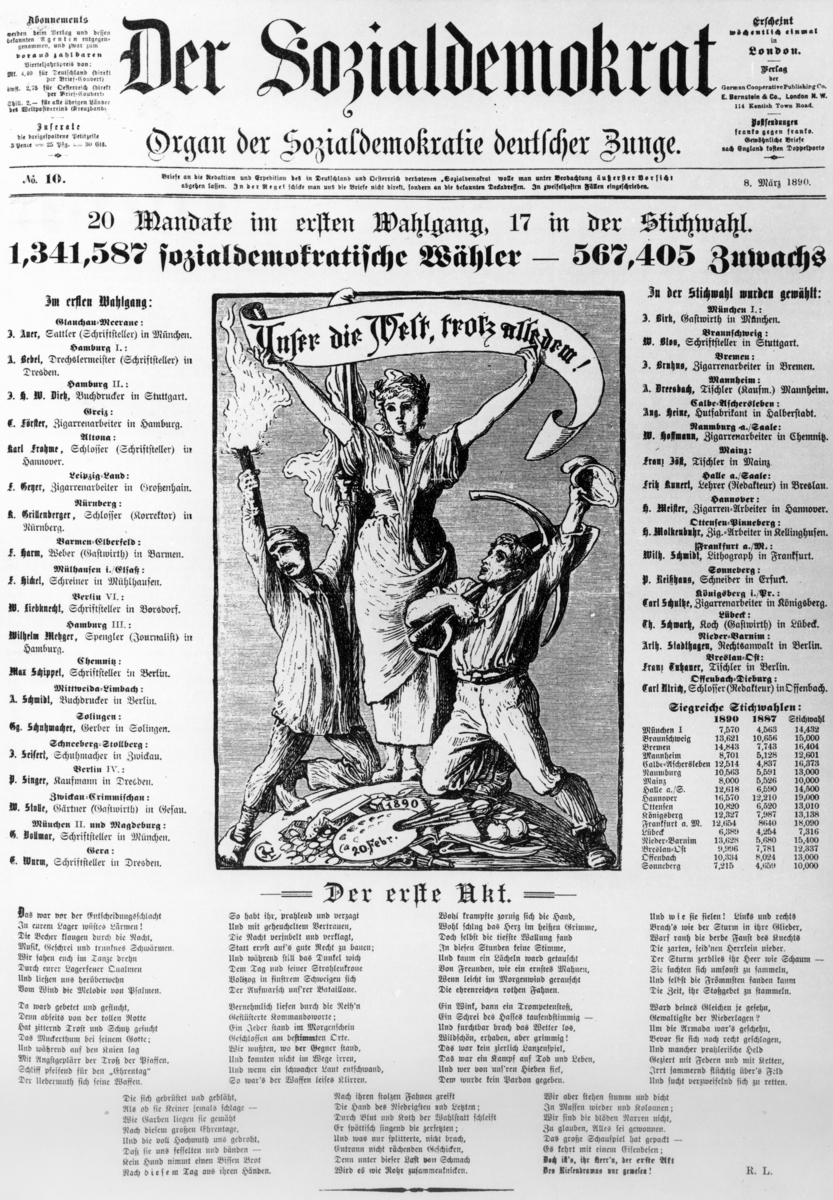
(The Social Democratic Party’s breakthrough in the Reichstag elections of February 20, 1890, is trumpeted in this facsimile of the front page of the party’s leading newspaper, Der Sozialdemokrat, on March 8, 1890. By that point, it was known that the SPD had won 20 Reichstag seats in the main elections and an additional 17 seats in the run-off ballots held in the intervening weeks. For the first time in its history, the SPD had garnered more votes—over 1.3 million—than any other party. The central figures hold a banner that reads: “Despite everything, the world is ours!” The title of the poem at the bottom, “The First Act,” conveys the same message: this victory is only “the first act” leading to still greater socialist triumphs in the future.)
And here is the detail the modern DSA should find most uncomfortable: the SPD did carry out a famous purge at Erfurt—at the very congress that adopted the program. Its target was a faction called Die Jüngen, young Berlin radicals who sneered at electoral politics as “parliamentary cretinism,” denounced the leadership as sellouts, and demanded confrontation instead of coalition-building. Friedrich Engels himself dismissed them as a “revolt of the literati and students.” The party expelled their ringleaders; the rest walked out, drifted toward anarchism, and within a few years were a footnote.
Notice the direction of that purge. The SPD did not expel people for being insufficiently pure. It expelled people who refused to do the patient, unglamorous work of winning elections and delivering material gains. The party’s first great act of discipline was aimed squarely at its purity faction—at the people who preferred the moral comfort of confrontation to the hard business of assembling a majority.
The modern DSA has taken the same disciplinary machinery and pointed it in exactly the opposite direction. Ocasio-Cortez was not cast out for abandoning electoral politics. She was cast out for succeeding at it.
Building the “State Within a State”
The modern American left often mistakes viral social media moments and protest turnout for actual political power. The SPD made no such mistake. They understood that true political power requires institutional infrastructure.
They built what historians call the “socialist milieu”—a cradle-to-grave ecosystem that insulated workers from the hostile conservative state. If you were an SPD member, you read SPD newspapers, shopped at socialist consumer cooperatives, sang in socialist choirs, and relied on socialist mutual aid societies. Voting for the party wasn’t just a political choice; it was an expression of community identity.
By contrast, the DSA’s current trajectory threatens to shrink its footprint to a handful of hyper-educated urban enclaves. You cannot build a mass movement—a true “milieu”—if your door is guarded by a bouncer checking everyone’s stance on a Middle Eastern conflict before they are allowed to fight for universal healthcare.
The Narcissism of the Safe Seat
To understand just how far the DSA has strayed from sound socialist strategy, look at where they run, and who they attack.
The historical SPD expanded their power by running candidates in nearly every district across the German Empire. They did this to build a genuine, nationwide mass movement. Then, when the runoff elections happened, they pragmatically allied with Left-Liberal candidates to defeat the conservative right. In 1912, a quietly negotiated runoff pact with the liberals helped propel the SPD to 110 seats, making it the largest party in the Reichstag.
The DSA has adopted the exact opposite approach. Operating within the American first-past-the-post system, the DSA knows that running as a third party in a general election acts as a spoiler that elects Republicans. So, they run inside Democratic primaries.
But instead of doing the hard, necessary work of expanding the progressive map into working-class purple or red districts, the DSA focuses almost exclusively on deep, safe blue urban enclaves. Their strategy is not to flip seats from the right. Their strategy is to capture already-blue seats and try to make them “darker blue.”
And who are they spending precious money and thousands of volunteer hours to unseat? They are primarying mainstream progressive Democrats—the exact modern equivalent of the left-liberals the SPD successfully allied with.
This is where the strategy goes from lazy to actively destructive. If you place the platform of a DSA challenger next to the mainstream progressive incumbent they are trying to oust, there is almost zero daylight between them on material domestic issues. Both want universal healthcare. Both want robust labor protections. Both want aggressive climate action.
The only real difference—the sole justification for declaring war on an ally—is the DSA’s militant anti-Zionist litmus test.
They are using the primary system not to advance democratic socialism, but to purge progressive Democrats who refuse to adopt their exact, uncompromising rhetoric on Israel. The historical SPD understood that the conservative right—the people actively crushing workers—was the ultimate enemy. The modern DSA seems to believe their ultimate enemy is a progressive Democrat in a safe blue seat who supports a two-state solution.
When you use your limited resources to cannibalize your closest ideological neighbors over a single foreign policy issue, you aren’t building a working-class revolution. You are just fighting for control of a very small, very pure treehouse.
Reclaiming the Strategy of Attrition
The SPD’s chief theorist, Karl Kautsky, called their approach the “strategy of attrition.” Capitalism would not be overthrown in a single glorious weekend. It required patience, institutional endurance, and the slow, steady accumulation of political power through massive, disciplined majorities.
The modern DSA stands at a crossroads. It can continue down the path of the purity spiral, disowning its most effective champions, enforcing foreign policy litmus tests, and shrinking into a politically marginal sect.
Or it can learn from history: the greatest socialist victories came not from demanding absolute ideological conformity, but from organizing workers around shared material interests, building durable community institutions, and forging tactical alliances to defeat the reactionary right.
The German SPD built a machine that shook an empire. The American left can do the same, but only if it decides that it actually wants to win.