Category Archives: Uncategorized

After the Launch: What Workers’ Capital Should Do About SpaceX Now

The rocket flew, the stock popped, and the index is about to do the rest. The fight over the largest IPO in history is not behind us. It is just beginning — and it has to be fought from outside the firm.

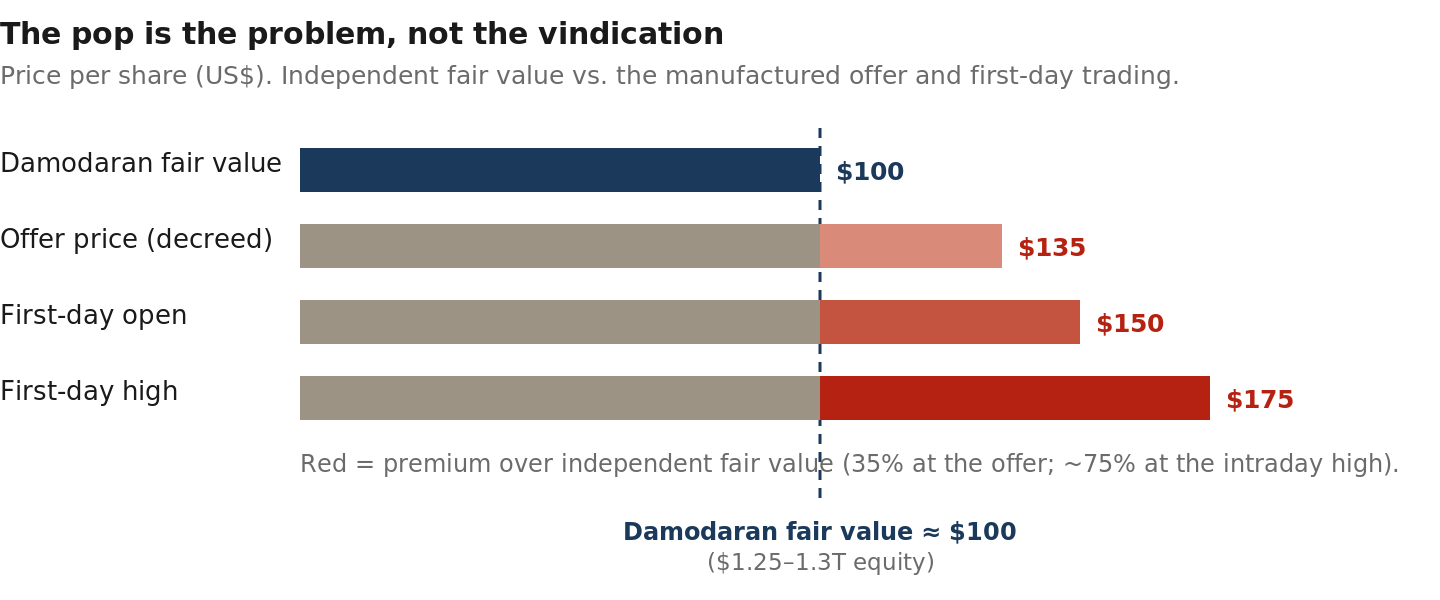
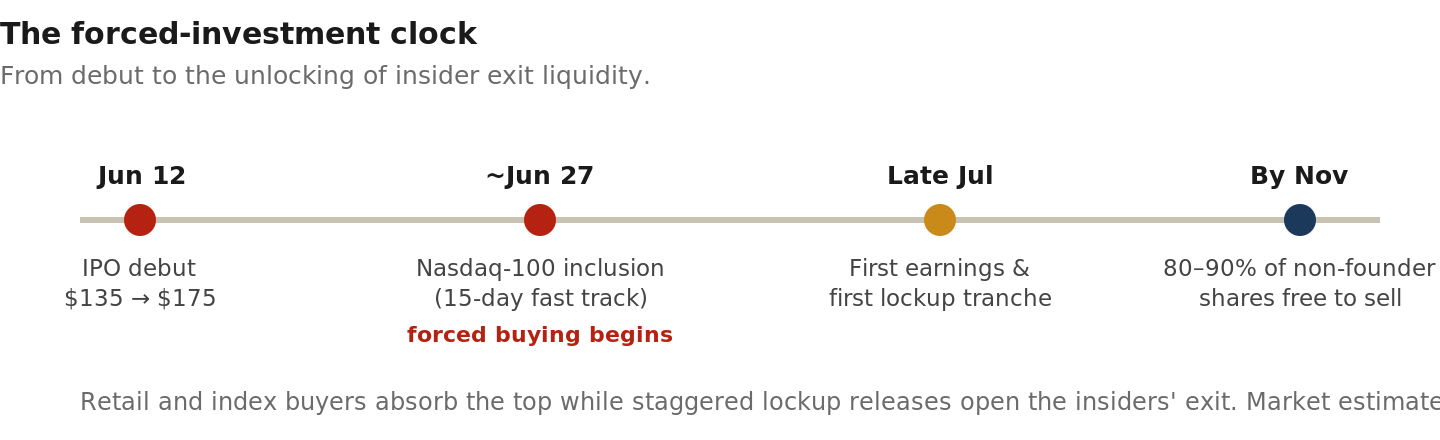
Ten days ago Space Exploration Technologies Corp. debuted on Nasdaq in the largest initial public offering in the history of capitalism. The price was not discovered; it was decreed — $135 a share, fixed before the roadshow, take it or leave it. The stock opened at $150 and touched $175, valuing the company at roughly $2.2 trillion, more than Meta. Elon Musk became, on paper, the world’s first trillionaire, and the financial press called it a vindication. It was nothing of the kind. A first-day pop does not prove a price was right; it proves the marketing worked. PetroChina popped too. Facebook popped, then left the investors who bought its IPO underwater for fifteen months.

The question I posed before the offering — should workers’ capital buy into the SpaceX IPO? — has not expired with the debut. It has changed shape. The trustees of public-sector pension systems and jointly trusteed union plans are no longer deciding whether to place an order. Within days, Nasdaq’s rewritten index rules will pull SPCX into the Nasdaq-100, and the decision will be made for them: every index fund, every target-date vehicle, every teacher’s 403(b) that tracks the market must then buy this stock automatically, in proportion to a market capitalization that was itself manufactured. The American Federation of Teachers, whose 1.8 million members participate in funds holding some $3 trillion, took the unprecedented step of asking the SEC to scrutinize the deal, warning of “forced investment.” They were right. What is coming is not an investment decision at all. It is a conscription.

So the post-IPO question is not whether to buy. It is what labor and the progressive shareholder-activist movement should do now that the buying has been taken out of their hands. To answer it, I want to return to a piece of theory I worked out in the Cambridge Journal of Economics some years ago — because the SpaceX structure is not an aberration. It is the purest illustration yet of the problem that theory was built to name.

The governance option, and why it is missing here

Begin with the firm itself. The dominant theory of the corporation, descended from Berle and Means and refurbished by the agency-cost school, rests on a comforting premise: ownership and control are separate, managers are mere agents of dispersed shareholders, and any manager who misallocates capital is disciplined by the “market for corporate control.” Capital markets, on this view, are neutral plumbing that converts millions of buy-and-sell decisions into legitimate outcomes. I argued, following Christos Pitelis, that the picture is false at its foundation. There was no managerial revolution. Capitalists did not surrender control when they sold shares to outsiders; they kept it, commanding socialized labor and social resources from a minority economic stake. The firm is not plumbing. It is an island of conscious power — and once you see it that way, a problem the orthodox account cannot handle appears: legitimacy. The people on the receiving end of corporate power, workers as employees and as the ultimate owners of pension capital, will eventually want a say in whether its outcomes are legitimate. Securities law, fiduciary duty, and shareholder rights are the residue of earlier moments when they demanded one.

The orthodox defense leans on a single load-bearing assumption Pitelis called perfect substitutability: that a worker who dislikes how a company behaves can simply sell. But pension beneficiaries cannot easily sell. They have no control over, and often no knowledge of, the shares bought in their name; they cannot move fluidly between consumption and investment the way the theory requires. They are involuntary investors — hostages to the decisions controlling capitalists make about corporate profits. Their “exit” is largely a fiction, and when exit goes dark, the price signal that is supposed to discipline managers goes dark with it. Absent some other intervention, workers’ deferred wages are quietly “put” back to the capitalist class as capitalist savings — fuel for accumulation, deployed by others, in others’ interests.

What is the other intervention? I called it the governance option. A share is a bundle of rights. Hedge-fund activists care about one strand, the right to payouts; but the bundle also contains governance rights — to vote on major decisions, to obtain information, to speak at the annual meeting, and to bring derivative claims against directors who loot the company. These are an embedded option, and for decades pension funds let it lapse, delegating their votes to Wall Street managers who, dependent on corporate relationships, reliably sided with management. The option expired unexercised, like a weapon never drawn. Labor’s contribution over the last two decades has been to start exercising it: at Tesla, where the CtW Investment Group and allied funds forced board changes; at Facebook, where union-led plaintiffs sued and made Zuckerberg withdraw a plan for non-voting Class C shares. Exercised collectively and credibly, the governance option is the one tool that lets non-controlling owners push back against the private power concentrated inside the firm.

Now look at the SpaceX prospectus with that framework in hand, and you can watch each strand of the bundle being severed in advance.

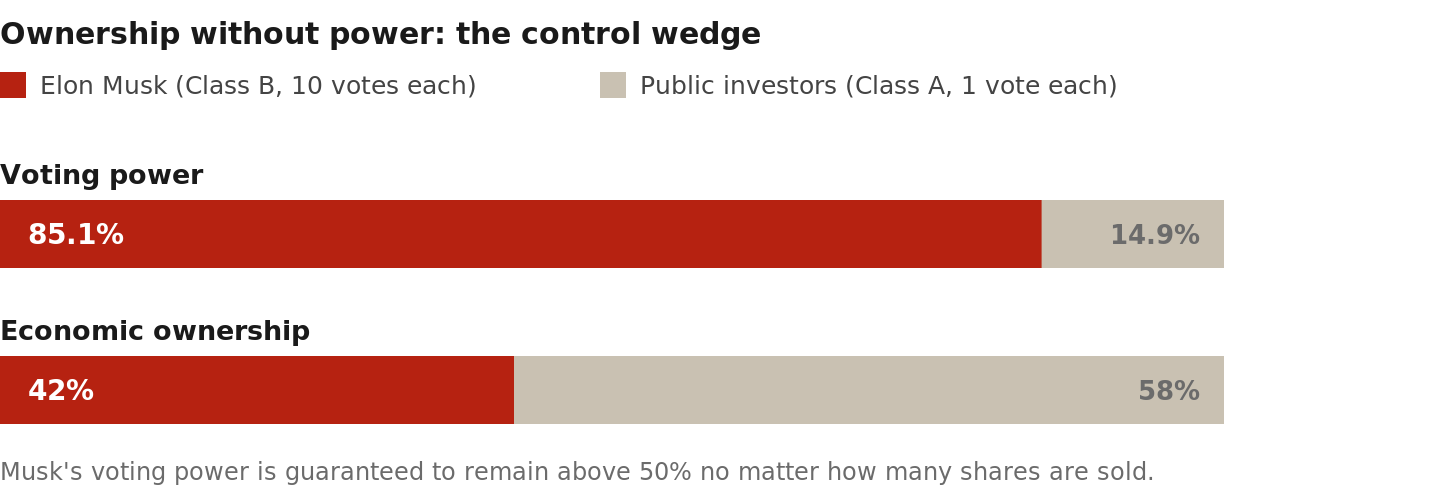
The vote is decorative. Public buyers get one-vote Class A shares; Musk’s Class B shares carry ten votes each. He commands 85.1% of the votes on 42% of the economics — permanently. He can be removed only by a Class B vote he himself controls. Source: SpaceX final registration statement.

The vote is hollow: 85.1 percent of the voting power sits with the founder, locked above a majority forever. The derivative suit — the remedy by which shareholders have policed self-dealing since the nineteenth century — has been priced out of existence. SpaceX reincorporated in Texas in February 2024, days after Delaware’s Chancery Court struck down Musk’s Tesla pay package, and Texas supplies a statute requiring a 3 percent stake before a shareholder may bring a derivative claim — more than $60 billion at today’s valuation, more than any pension system on earth holds in any single stock. The rights to informationand to voice at the annual meeting are nominal in a company whose board is a closed circle of the founder’s friends and co-investors; the “controlled company” exemption strips away even the usual independent-board requirements.

In other words, the SpaceX structure does not merely exploit a lapsed governance option. It is engineered, in advance, so that there is no option left to exercise — the embedded rights emptied out before the first share changes hands. Then, with index inclusion, the last strand, exit, is severed too. This is imperfect substitutability taken to its limit: workers as maximally hostage investors, unable to refuse the purchase and unable to sell, holding a security stripped of voice and of legal remedy. Participation without consent, exposure without voice. That is not a market relationship. It is tribute.

A great company can still be a terrible security. NYU’s Aswath Damodaran — the nearest thing American finance has to a neutral arbiter — values the equity near $100 a share using assumptions he calls generous. The prospectus asserts a $28 trillion “total addressable market,” $26 trillion of it AI; he judges that figure to “border on fantasy.” Sources: Damodaran post-prospectus analysis, June 4, 2026; SpaceX prospectus.

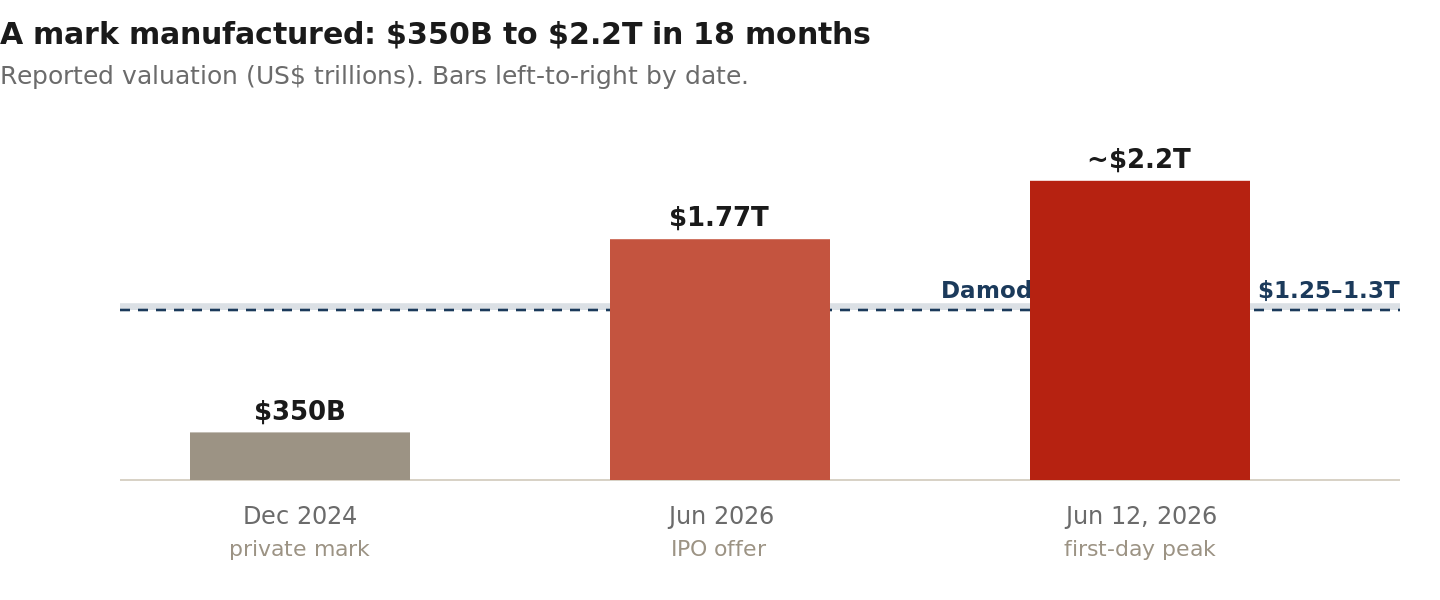
How did a $100 security come to be priced at $135 and trade at $175? Not through discovery. SpaceX was marked at $350 billion in December 2024; fourteen months later the figure was $1.25 trillion — a step-up built on tiny secondaries to obscure offshore vehicles, with undisclosed parties on both sides, and the $250 billion absorption of xAI, a Musk-controlled company bought by a Musk-controlled company. That this was a deal Musk negotiated, in effect, with himself is not my characterization alone; it is how independent observers described the transaction. The IPO was the first arm’s-length price test of this security in years; its buyers were not relying on price discovery but performing it, with their own money.

What independent observers said about the deal

“Musk negotiates with himself, sets the terms, and outside shareholders absorb the risk… the vehicle for value creation is not actual business performance—it’s Musk shuffling assets between entities he controls and stamping a higher valuation on the combination.”
— Fred Lambert, Electrek, May 27, 2026, on the $250B SpaceX–xAI deal

Of the earlier xAI–X combination that set the template, William Cohan asked whether “any bankers [were] hired to value the two companies and set an exchange ratio” or whether “special committees of the boards of directors [were] set up to… make sure it was fair to the non-Elon shareholders.” Bloomberg’s Matt Levine judged the valuation “not clearly validated by arm’s-length transactions with economically motivated counterparties.”
— quoted in Mike Masnick, “The X/xAI Shell Game: When Musk Merges With Himself,” Techdirt, April 7, 2025

And on what the structure leaves for outside shareholders, NYU’s Aswath Damodaran found in the prospectus “a voting share structure that locks in Elon Musk’s control of the company, since there is little that shareholders can do to restrain the company.”
Aswath Damodaran, “Revisiting the SpaceX Valuation,” June 4, 2026

The valuation outran any independent estimate of value. The step-up rested on thin secondary trades with undisclosed counterparties and the $250B absorption of xAI — a deal independent observers described as Musk negotiating “with himself” (Electrek; Techdirt). Sources: SpaceX prospectus; reported December 2024 mark; Damodaran, June 2026.

Why “engage from the inside” cannot be the answer this time

The sophisticated counsel inside the labor-investment world says: engage. This is the first of a wave — OpenAI and Anthropic will follow — and a movement that spent four decades building credibility cannot sit out the defining transaction of the era. Better to enter in coalition, with published conditions, and fight from within, as we did at Tesla. I helped build that engagement tradition and respect its instincts. But engagement presupposes channels of influence, and this issuer has closed every one in advance. We ran the experiment: in 2016 CtW’s funds and allies, managing some $700 billion, warned Tesla’s board about the SolarCity related-party deal; in 2018 I took the floor of its annual meeting and urged shareholders to vote against Musk’s captive directors. Engagement under Delaware law, with courts and derivative suits still available, yielded redomestication to Texas and a bigger pay package. SpaceX offers strictly worse terrain — no vote that counts, no court a pension fund can afford to reach, no independent board, and now no exit. A condition-based strategy with no enforcement mechanism is not a strategy. It is a press release with a wire transfer attached.

If the governance option has been emptied inside the firm, then the response cannot be conducted inside the firm. It has to push on the boundary of the firm from outside — what Engels, in a passage I have always found startlingly contemporary, called the invading socialist society pressing inward against the wall of private appropriation. The good news is that labor has done exactly this before, and it worked.

The PetroChina campaign taught that even at the heart of the financial system, organized refusal from below can reprice a deal and rewrite a rule. The stakes now are larger — because the capital being requisitioned is labor’s own.

In 2000, a Goldman-led syndicate set out to float PetroChina on the New York Stock Exchange and hoped to raise $10 billion. The AFL-CIO, joined by human-rights and religious organizations, mounted an “alternative roadshow” that trailed the underwriters city to city, and the deal was slashed to under $3 billion. It left a regulatory residue too: in the 2001 Unger Letter, the SEC conceded for the first time that an issuer’s human-rights conduct could be material to investors — proof that the wall between “financial” and “social” information is not a fact of nature but a political settlement, open to renegotiation. That is the model, scaled up for the age of the trillion-dollar founder. Here is what it looks like now.

An agenda for the post-IPO fight

1. Move the fight to the index layer—the new frontier of the exit problem.

This is where the forced-investment fight will be won or lost, and it is the most urgent item on the clock. The mechanism that strips workers of exit is no longer the trading desk; it is the index committee. Reuters reported that SpaceX made fast-track inclusion a condition of listing, and Nasdaq rewrote its rules so a mega-listing can enter the Nasdaq-100 in fifteen days instead of months. Labor should contest fast-track inclusion directly and press the broader principle the moment demands: that benchmark providers adopt governance standards excluding — or weighting down — securities with no meaningful vote and founder lock-in, as index families have restricted multi-class structures before. And trustees should reassert that they never delegated their fiduciary judgment to an index committee’s rulebook. “The index made us buy it” is an abdication, not a defense.

Conscription, then exit. Index funds are forced in just as insider lockups begin to release. Insiders who put less than $11 billion of equity into the company over its lifetime sell into the enthusiasm of the people who cheer the rockets. Sources: Reuters; market lockup estimates; SpaceX prospectus.

2. Rebuild the governance option through law and disclosure, not boardroom diplomacy.

If the rights inside the share have been emptied, refill them from outside the firm, through the regulatory and legal channels engagement bypasses. That means a coordinated wave of SEC comment letters pressing the questions the prospectus finesses: the roughly $205 billion of goodwill atop a subsidiary whose eleven co-founders have all departed; the Starlink unit economics that fell from $99 to $66 in monthly revenue per subscriber while the valuation tripled; the $28 trillion addressable-market claim. It means building, on the PetroChina/Unger foundation, the materiality case that governance and labor conduct are financial facts, not soft “social” ones. And it means treating the Texas 3-percent derivative threshold as a target for litigation and legislative reform — a remedy priced out of existence, not constitutionally abolished.

3. Reclaim the option from the intermediaries who keep “putting” it back to management.

The governance option lapses because pension funds delegate their votes and stewardship to Wall Street managers whose business depends on cordial relations with the very insiders they are meant to police. The largest index providers will be among the biggest holders of SPCX, and their voting policies will matter more than any single fund’s. Labor’s task is to build independent stewardship capacity — in-house proxy voting, shared voting platforms among allied funds, public guidelines that refuse to rubber-stamp controlled-company structures — so the option is exercised by the beneficiaries’ representatives rather than surrendered on their behalf. An option never exercised loses its credibility, like a weapon never drawn; a credible threat changes behavior before it is used.

4. Unite the two roles: workers as owners and workers as employees.

SpaceX is not merely an overpriced, unaccountable security. It is the company that sued to have the National Labor Relations Board declared unconstitutional after firing workers who criticized Musk — and won by attrition this February, when a hollowed-out Board abandoned its case. Reuters has documented more than 600 worker injuries at its facilities, including amputations and a death. The proposition put to a union trustee is therefore obscene on its face: hand the deferred wages of union members, at a 35-to-75 percent premium to fair value, to a company dismantling the legal regime under which those same members organized — in exchange for a share with no vote, no court, and no board. The old worry that prudence and solidarity might conflict dissolves here; they point the same way. Owner-side and worker-side institutions should run this as one campaign, not two.

5. Refuse loudly, on the record, and be candid with beneficiaries about why.

Finally, the alternative roadshow for the age of the trillion-dollar founder: a documented, public, rigorous refusal. Restricted lists. Written-justification requirements for any manager who wants in over a fund’s own benchmark. And honest communication with the teachers, firefighters, and nurses whose savings are at stake — not squeamishness about rockets, but a refusal to let workers’ own capital finance a structure built to be unaccountable to them in both of their roles. The objection was never that the rockets do not fly. Launch margins near 67 percent and Starlink subscribers doubling to 10.3 million are real. A great company can still be a terrible security, and an unaccountable one can still be a political defeat.


Step back and the historical shape comes into view. The postwar settlement bought social legitimacy with institutions — bargaining, social insurance, enforceable rights — that gave the working class procedural standing. The neoliberal era stripped those away and offered a substitute: the worker as shareholder, the pension fund as each citizen’s stake in capitalism’s success. The SpaceX offering abolishes even that bargain’s formal terms — no meaningful vote, no court, no independent board, and now, through index capture, no exit and no entry decision either. A system that must conscript its own working class’s savings while litigating to dissolve that class’s last statutory protections is not generating legitimacy. It is running down reserves accumulated in an earlier age, and the deficit is compounding.

The price is set; the stock has popped; the index will do the rest. None of that settles the question the workers’-capital movement has always posed — whether the class that produces society’s resources will have any say in how they are deployed. The governance option has been emptied inside this firm. So it must be exercised against the structure from outside: at the index committee, at the SEC, in the legislature, and in public. The point was never to catch the biggest deal in history. The point is to contest it.


Stephen F. Diamond is a corporate and securities law scholar who has advised union pension funds for three decades, including the AFL-CIO’s PetroChina IPO campaign (2000) and the CtW Investment Group’s engagements with Tesla’s board (2016–18). The argument here develops the framework of his article “Exercising the ‘governance option’: labour’s new push to reshape financial capitalism,” Cambridge Journal of Economics 43, no. 4 (2019): 891–916. Valuation figures draw on Aswath Damodaran’s June 2026 analysis and the SpaceX registration statement; first-day trading, lockup, and index-timing figures reflect reporting as of June 22, 2026.

A Powerpoint summary of this post can be found here: Should Workers Capital Buy Into the SpaceX IPO (deck).

The Night Before the Escalation: What Two Firings May Tell Us About What’s Coming in Iran

On Wednesday night, President Trump told the country that Operation Epic Fury — the U.S.-led military campaign against Iran — was nearing its objectives. Iran’s navy, he said, was gone. Its air force was in ruins. Most of its leaders were dead. Yet in the same address he warned that American forces would hit Iran “extremely hard over the next two to three weeks.”

That is the tension at the center of this moment. Trump says victory is close, but his own timeline suggests that the most consequential phase of the war may still lie ahead.

By the next day, two of the most structurally important figures in the national security apparatus were out.

Attorney General Pam Bondi had been fired, and Todd Blanche was elevated to acting attorney general. Hours later, Defense Secretary Pete Hegseth removed Army Chief of Staff General Randy George, along with two other senior Army generals. Each move has a facially plausible bureaucratic explanation. Bondi’s standing had reportedly deteriorated amid dissatisfaction over the handling of the Epstein files. George’s ouster was publicly framed as a leadership change rather than the product of any specific controversy.

Maybe that is all this was. But the timing is too striking to ignore.

To see why, it helps to focus more on institutions than on personalities. What mattered about Bondi and George was not simply who they were, but what their offices were positioned to do at a moment when the administration was openly preparing the public for escalation.

The Army Chief of Staff is not a battlefield commander. Under the post–Goldwater-Nichols structure, the operational chain of command runs from the President to the Secretary of Defense to the combatant commander — here, CENTCOM. The service chiefs sit outside that chain. Their role is different: they help organize, train, and equip the force, assess readiness, and advise civilian leadership on whether the Army can sustain an expanded operational tempo without unacceptable strain on other commitments in Europe, Korea, or the Pacific.

That is not a ceremonial function. It is one of the principal ways institutional friction enters the system.

The Chief of Staff also sits on the Joint Chiefs, where the service chiefs serve as formal military advisers to the President and the Secretary of Defense. If a service chief raises a formal objection to a deployment, a pace of operations, or a plan that would overextend the force, that objection can become part of the institutional record. It creates friction. It creates accountability. It forces civilian leaders to override professional military advice consciously rather than glide past it unnoticed.

General George had already been operating in that space. Days before his firing, he authorized combat patches for soldiers deployed in support of Epic Fury, a quiet but meaningful acknowledgment that the Army was serving in a combat zone. His views on readiness and sustainability would likely have mattered in any decision to deepen the Army’s role in the conflict, especially because the administration has not entirely foreclosed additional ground deployments even while insisting that its objectives can be achieved without a full-scale ground invasion.

The attorney general occupies a different institutional position, but one that is no less important.

The Justice Department’s Office of Legal Counsel is the executive branch’s principal internal source of controlling legal advice. OLC does not act alone; Congress, the courts, military lawyers, and agency counsel all shape the legal environment of war. But OLC helps define the executive branch’s legal position on the questions that matter most in a conflict: how to interpret the War Powers Resolution, how long hostilities may continue without additional congressional authorization, what legal theories justify the use of force, and what legal limits govern detention and treatment.

The attorney general does not personally write those opinions, and the head of OLC is a Senate-confirmed official. But the attorney general still matters enormously. The office shapes institutional culture, supervises the department in which OLC sits, and influences whether executive power is construed broadly or narrowly when the stakes are highest.

That is what makes Bondi’s replacement significant. Todd Blanche is not merely a new acting attorney general. He is a former Trump personal defense lawyer who most recently served as Deputy Attorney General. His elevation may say less about legal doctrine than about institutional posture. At a moment of possible escalation, the administration appears to prefer proximity and loyalty over distance and independence.

Taken one by one, these firings can be explained away. Taken together, in the hours surrounding a presidential address promising a more intense military campaign, they look more consequential. Two important sources of institutional friction — one military, one legal — were removed just before the administration entered what Trump himself described as a decisive two-to-three-week period.

That does not prove motive. It does not establish that either official had resisted escalation, or that either would necessarily have done so. But it does raise the question whether the administration is reducing the number of internal actors positioned to slow, question, or formally complicate what comes next.

That question should not be treated lightly. Congress, which still bears constitutional responsibility for war powers oversight, should be examining these moves with real urgency. The War Powers timetable is already running. Questions about sustainability, force posture, and munitions capacity are emerging. And while administration officials have said current objectives can be achieved without a ground invasion, they have stopped short of definitively ruling out deeper military involvement.

In Washington, personnel is often policy in its clearest form. When an administration removes institutional friction immediately before a promised escalation, it is reasonable to ask what that friction might have constrained.

We may get the answer soon enough. The President himself has given the country the timeline: two to three weeks.

Stephen F. Diamond is a law professor and political scientist, and a former MacArthur Foundation Fellow in International Peace and Security at Harvard University’s Center for International Affairs.

Delaware Chancery Court slaps Elon Musk’s wrist on SolarCity deal

Tesla shareholders won an important victory for shareholder rights today, at a time when Silicon Valley CEO’s continue to try to wrest power away from their investors through various mechanisms like non-voting stock (SNAP) and dual and triple class capital structures (Google, Facebook, Theranos).

The Delaware Chancery Court denied a motion to dismiss by Tesla in a lawsuit over Tesla’s controversial acquisition of SolarCity.

The close ties between Tesla CEO Elon Musk and his board members at the time of the SolarCity acquisition were clearly a concern for the Delaware Chancery Court. That Tesla has now added two new independent board members is an important acknowledgement that Tesla had a problem prior to this point in time because Tesla’s board was not sufficiently autonomous from Musk.

Technically what happened here is that the Court agreed with the plaintiff shareholders that it would be reasonable to conclude that Musk “controlled” the Tesla board and thus judicial review of the merger vote is subject to the most exacting standard of review, known as “entire fairness,” as opposed to the more deferential “business judgment” standard. Cases like these rarely get dismissed. Now, Tesla will face full discovery of its internal records and a possible trial on the merits or look to settle the case.

One interesting comment by the Court: the judge compared this situation with the Dell MBO and concluded that there Michael Dell took important steps to separate himself from the Board when it considered the acquisition offer from Silverlake et al. But here Musk took “practically no steps to separate [himself] from the Board’s consideration of the Acquisition.”

Does the California State Bar have a race problem?

A recent meeting of the State Bar’s Committee of Bar Examiners (CBE) suggests to me that the California Bar may have a problem with race. That is, its leaders do not understand or are not willing to accept that they are putting up a barrier to minorities who wish to practice law. The evidence of this potential problem is found in the tape of the hearing which you can view here as well as a report prepared by the Bar Association’s staff on the bar exam.

The CBE chair, Karen Goodman, who readily admits (Min. 48:00) that she is from “Elk Grove” (a small town south of Sacramento that is, ironically, quite racially diverse) and so may not understand the data presented to her, questions whether lowering the “cut score” (the minimum number of points needed to pass) on the bar exam would help improve access to justice.

Yet, the data presented to the CBE she chairs indicates clearly that lowering the cut score even a modest amount (and still at a level well above that of New York state) would significantly increase the number of minority lawyers in the state. And this would be true in a state bar that remains overwhelmingly white and male and older, despite significant demographic shifts in the state over the last few decades.

The Bar staff report concluded: “…applicants of color pass the [current] bar exam at rates that are disproportionate to those of their white counterparts.This impact, when combined with disproportionately lower numbers of people of color in the pipeline to higher education and law school, has resulted in a pool of licensed attorneys in California that does not reflect the population of the state.”

And CBE Chair Goodman seems to go out of her way to minimize the impact of not lowering the cut score by suggesting, without any basis, that newly admitted minority lawyers won’t be of any assistance to the communities from which they came because they may not return to work in those settings. She apparently believes, despite decades of experience with affirmative action and other programs suggesting the contrary, that the only way they help those communities is by going back to them!

In any case, she and others on the CBE seemed unfamiliar with the debt repayment plans and financial support for those who go into public interest legal positions that are available to many law school graduates, thus opening a pipeline to enable lawyers to return to those communities. Of course, if we arbitrarily limit the number of minority lawyers that goal is not going to be easy to meet.

The Bar staff report also concluded that lowering the cut score would likely not have any impact on the number of attorneys subject to discipline by the bar, thus the Committee’s mandate to protect the public would still be met: “…attorney discipline – as measured by private and public discipline per thousand attorneys – appears to have no relationship to the cut score….based on the data available, it appears unlikely that changing the cut score would have any impact on the incidence of attorney misconduct.” (p. 36 of the Report to the Board of Trustees of the California State Bar Final Report on the Standard Setting Study and Public Comments Regarding Pass Line Options September 5, 2017.)

Thus, while we do not know why the cut score is so much higher than needed to meet the primary mandate of the CBE (protection of the public), we do know that by setting it at 144 the Bar has put up a wall over which minority law school graduates have difficulty climbing with the inevitable outcome: a disparate impact on those hopeful new law school graduates.

(This is likely why the Bar staff recommended three options: leaving the score the same, lowering it slightly to 141 or lowering it further to 139, a point which would still be 6 points higher than New York. Despite the troglodyte nature of the CBE deliberations, the Board of Trustees voted 6-5 to send all three staff options to the Supreme Court, which remains free to accept or reject those, as it has ultimate authority now over the cut score.)

Goodman and others on the Committee also seem to be ignorant of the actual improving employment data for lawyers in California over the past several years. Instead of using the reliable longitudinal data of, for example, the Bureau of Labor Statistics (which show steady increases in the number of employed lawyers in California over the last decade as well as steady increases in average earnings), Goodman casually read aloud random and somewhat misleading ABA employment reports of various law schools. These only track the first ten months of a law school graduate’s career.

Amazingly, Goodman seems unaware what that means – given the very high cut score in California, many students require several expensive and demoralizing attempts to pass the bar and thus are unable to get jobs as lawyers in those first ten months.

Yet, many of those students will, in fact, eventually pass. They are only forced to delay their careers at great personal expense because of California’s irrational and baseless high passing score required by Goodman’s committee.

In other words, if Goodman and her Committee were truly motivated to improve access to the bar for minorities who wish to become licensed lawyers they could easily take steps to do so. But they have steadfastly refused to do that to date, instead punting the issue to the California Supreme Court. Hopefully, the Court will do the right thing and begin the process of restructuring the State Bar, including its committee structure and current leadership.

At a minimum, they should ignore the self-serving surveys conducted by the current Bar and 1) temporarily lower the cut score to the same level as New York (133 as opposed to its current 144); and 2) appoint a blue ribbon independent commission chaired by Dean Ferruolo of the University of San Diego School of Law to conduct a thorough study of the purpose, impact and structure of the bar exam with a mandate to propose any and all changes needed to improve access to, and effectiveness of, the legal profession in California.

California Bar opens door to increase in bar exam cut score

The State Bar of California has released a study today it conducted of the so-called “cut score” which determines who does and does not pass the California bar exam. Using the results of a focus group of 20 individuals the study concluded that the cut score could go as high as 150 (it currently stands at 144 – second highest in the country) or as low as 139. An accompanying memo from the Bar seems to suggest moving to 141 as the appropriate step. (The Committee of Bar Examiners will discuss today whether to propose lowering the cut score for the recent July 2017 exam only but will then conduct additional hearings before submitting a final recommendation to the Supreme Court.)

Yet the bar also admits there is little correlation between the bar cut score and lawyer competence and therefore consumer protection: “There is no empirical evidence available that would support a statement that as a result of its high pass line California lawyers are more competent than those in other states, nor is there any data that suggests that there are fewer attorney discipline cases per attorney capita in this state.”

But what stands out about the results is the fact that the 20 person focus group relied upon in the study had only 2 hispanic members but 10 white members. Hispanics out number whites in California and access to legal services by minority communities is a significant issue of concern. This raises the issue of inherent bias in the 20 person study group whose subjective views was the key source of input for the result which led to the study’s conclusions.

The Bar is conducting a meeting today to discuss the results. Video can be found here.

UPDATE: The Bar’s Committee of Bar Examiners voted today to send out for public comment two options: keeping the cut score the same and lowering the cut score for July 2017 only to 141.

Policy by committee is not a pretty process….

Another banner year for lawyers, BLS reports

The Bureau of Labor Statistics (BLS) is out with its annual employment report and the news is, once again, very positive for lawyers. Lawyers’ incomes and employment numbers have increased steadily over the last two decades (except for a decline in incomes in 2008 at the onset of the financial crisis).

The BLS reports that the total number of lawyers employed as of May 2016 was 619,530 compared with 609,930 the year before. Lawyers’ mean income was $118,160 compared to last year’s wage of $115,820.

The outlook here in California continues to be strong with 76,840 lawyers earning a mean annual wage of $162,010. This compares to 72,790 lawyers the year before who earned a slightly higher mean wage of $163,020.

The numbers in my region of Silicon Valley (Santa Clara County which includes Palo Alto but not Menlo Park) remain strong with 5,170 lawyers earning the nation’s highest mean wage of $197,320. This represents a correction against last year when there were 5,430 lawyers earning an annual wage of $204,010. This may reflect a shift in the epicenter of Silicon Valley to the social media companies now based in San Francisco. Lawyers employed there rose in the past year from 10,320 to 11,750 while incomes rose from $178,110 to $183,890.

I tracked earlier data here, here and here.

There are some caveats to the data. Solo practitioners and partners in firms are not included in this data. I examined the prospects for solo practitioners here. The former may fall below the means reported here, while partner incomes could easily outpace those of “employed” lawyers so that the overall effect of the exclusions is minimized.

Trump to channel Nazi Economy Minister Hjalmar Schacht?

David Frum took a shot today on KRCW at predicting what Trump’s economic policy is likely to be. Frum says it will be a heavy dose of debt financed spending on arms and infrastructure which will help boost industrial employment for (largely) white male workers. That will, Frum insightfully suggests, buy him some popularity, perhaps enough to guarantee a second term.

To those who think recalling history is important this should remind people of the policies implemented by the Nazis under Minister of the Economy Hjalmar Schacht. Massive infrastructure spending (the autobahn, for example) was linked to autarkic trade policy as a way to deal with the collapse of the German economy. The financial hunger of the Nazi regime soon turned to the assets of its Jewish population with Schacht (who expressed some opposition to the more extreme anti-semitism of the Nazi party) suggesting that Jewish property be held in trust by the government rather than outright expropriation.

Schacht funded the industrial and military expansion of the Hitler regime in part by the issue of a new basically fraudulent form of government debt known as MeFo Bills. These were used to hide a massive government debt. Today on CNBC Trump advisor Larry Kudlow basically admitted Trump would be forced to inflate debt in order to cover his planned spending because planned tax cuts won’t generate sufficient growth in GDP.

Countries that try to inflate their way out of economic problems end up in deeper trouble. The signs point to a similar path in the new Trump era.

Henry Manne, 1928-2015

Steve Bainbridge writes here of the passing of Henry Manne, one of the most important legal thinkers of the late 20th century. I did not know Henry at all personally until one evening a few years ago I was very pleased, out of the blue, to receive an email from him commenting on a paper of mine that had been posted on SSRN. That led to a brief but fruitful exchange of ideas about law and capitalism that proved very helpful in my own thinking and apparently, while he was perhaps just being polite in saying so, in his own thinking as well. Henry was someone who I think, alongside the late Benoit Mandelbrot whom I also was privileged to get to know in a similarly random way, should have received a Nobel Prize. Henry’s work and ideas will be of significance for a very long period of time and deserve careful study.